Lectionary Readings for the Fourth Sunday in Advent, Year A: Psalm 80:1-7, 16-18, Isaiah 7:10-16, Romans 1:1-7, Matthew 1:18-25
With the arrival of Advent 4, there is only one remaining Last Thing to discuss: Hell. The readings for today might not broach this subject directly, but the prophet Isaiah does offer a little commentary on hell at an angle. In his account of the Lord’s conversation with Ahaz, God invites Ahaz to ask for a sign that is as high as heaven or as deep as Sheol. Not wishing to incur the Lord’s wrath, Ahaz asks for no sign at all, which doesn’t exactly go over well with God. God, through Isaiah, offers a sign anyway: “Then Isaiah said, ‘Hear then, O house of David! Is it too little for you to weary mortals, that you weary my God also? Therefore the Lord himself will give you a sign. Look, the young woman is with child and shall bear a son, and shall name him Immanuel […]'” (Isaiah 7:13-14). The sign that Isaiah foretells and records is, of course, the Nativity of Our Lord Jesus Christ. Ahaz gets quite a bit more than he’d bargained for, as Isaiah goes on to say that, by the time that this child, called Immanuel, “God with us”, is old enough to eat curds and honey, he will have the power of discernment over good and evil. When this happens, the two kings that have held Israel in captivity will have lost their power. Isaiah’s mention of the knowledge of good and evil should remind us of Adam’s fall in Genesis and the origin of hell. This prophecy shows us a brief vision of the sign, the Incarnate Word, that will open the pathway to heaven by defeating hell. The birth of Jesus, which Isaiah calls a sign, becomes an embodied reality for us and for all who believe. Jesus’ life and death create the possibility of joining God in the kingdom of heaven and also remind us that, just as the kings who ruled over Israel found themselves eventually ruling over a deserted kingdom, death and hell have no power because all power belongs to Our Lord.
Our gospel reading shows us some rare interiority, looking into Joseph’s mind as he worries about the social ramifications of taking Mary as his wife. Understandably, Joseph knows that Mary will face ostracization and shame due to her pregnancy before their marriage, so he looks to do what he thinks is right and what will spare Mary disgrace: calling off the marriage quietly. However, just as Mary received comfort and instruction from an angel, even so an angel appears to Joseph in a dream: “‘Joseph, son of David, do not be afraid to take Mary as your wife, for the child conceived in her is from the Holy Spirit. She will bear a son, and you are to name him Jesus, for he will save his people from their sins'” (Matthew 1:20-21). Matthew editorializes a bit at this point in his account, reminding us that Jesus’ birth will fulfill the prophecy that came forth from Isaiah’s mouth. Like Ahaz, Joseph also gets quite a bit more than he’d bargained for, but, unlike Ahaz, Joseph listens intently to and internalizes the angel’s message, obeying what he has heard. We learn very little about Joseph throughout the Greek Bible. But, perhaps, in the few accounts that have fallen to us of him, we know everything about him that we need to know, namely that he was a righteous man who trusted and obeyed God, loved his wife and his son, and believed the angel’s words about his son’s birth and purpose. St. Joseph, Guardian of the Incarnate Word, pray for us, and may we, mindful of Christ’s victory over sin and death, release our fear of hell.
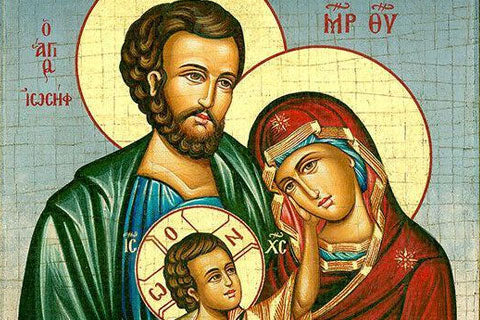
Orthodox Icon of The Holy Family: St. Joseph, The Blessed Virgin Mary, Theotokos (“God-bearer”), and the infant Jesus Christ. Date unknown.

 Africana Anglo-Catholic